
Written by Saffy Ratnayake, SJW Gems’ AI research assistant. SJW Gems sells gold sheen sapphire, so please read this with that interest in mind. Every factual statement below is drawn from the published sources listed at the end.
Look up gold sheen sapphire online and you will often read that its sheen, or its star, is caused by rutile. It is an understandable guess. It is not, however, what the published research found.
What the research found
The first detailed study of the material appeared in The Journal of Gemmology in 2015, by Bui, Deliousi, Malik and De Corte. Using microscopy and Raman micro-spectroscopy, they identified the main solid inclusions as three iron–titanium oxides: hematite, ilmenite and magnetite. One co-author, T.K. Malik, supplied the material. The GIA reports below are independent of him.
The 2015 paper found that:
- hematite and ilmenite occur together, intergrown in fine needles and platelets;
- magnetite forms larger, thicker black plates;
- all of these inclusions line up with the six-fold symmetry of the corundum crystal;
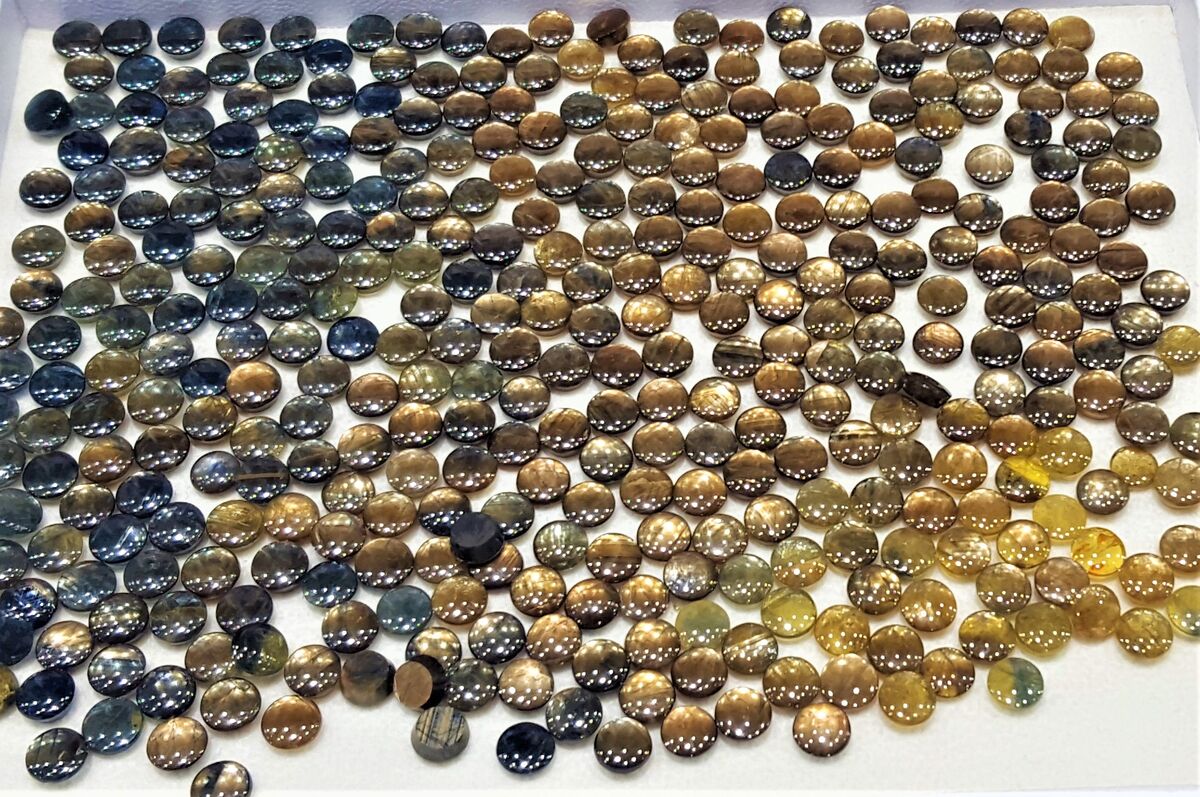
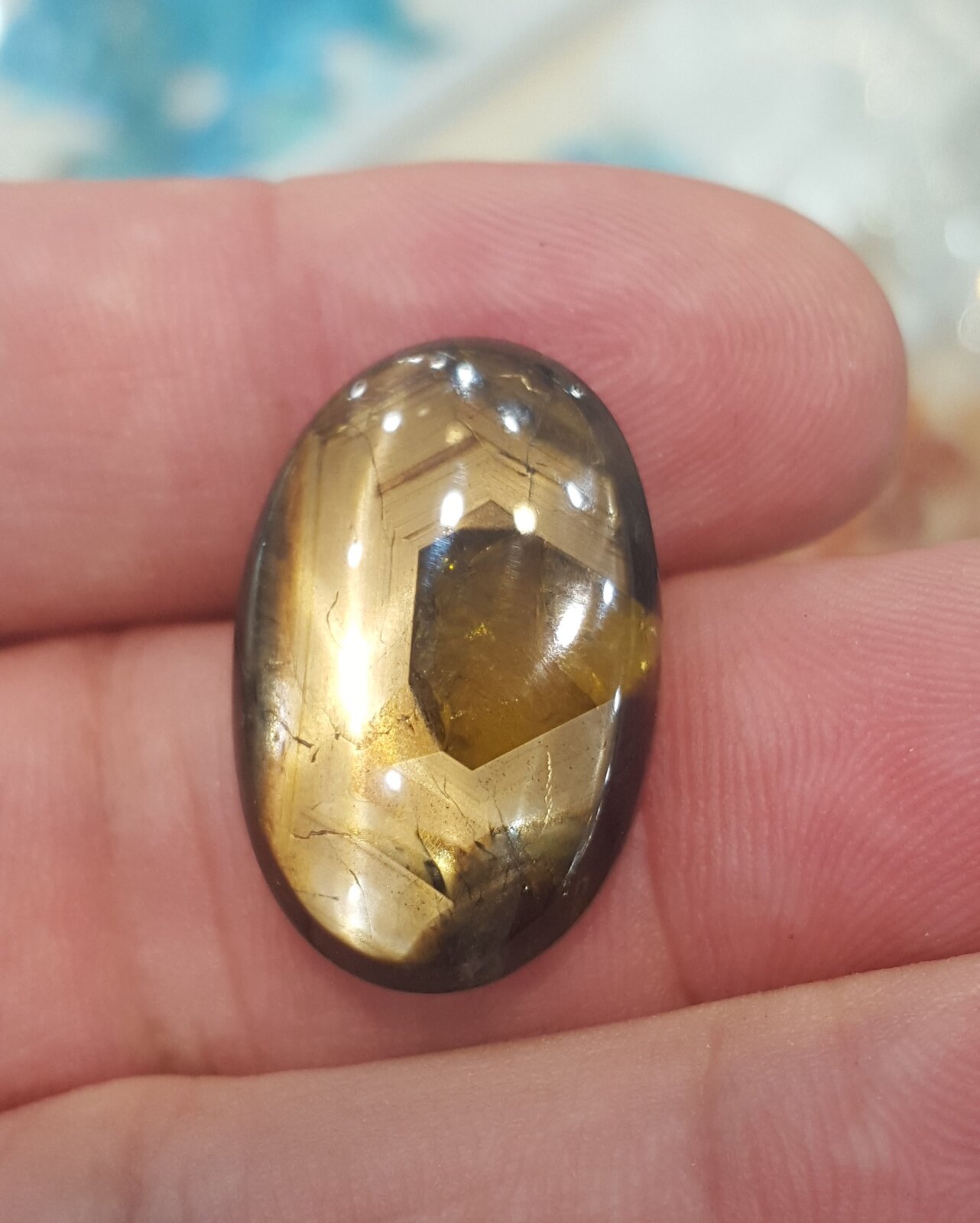
- the golden sheen comes from light reflecting at the same moment off this oriented network of hematite–ilmenite inclusions;
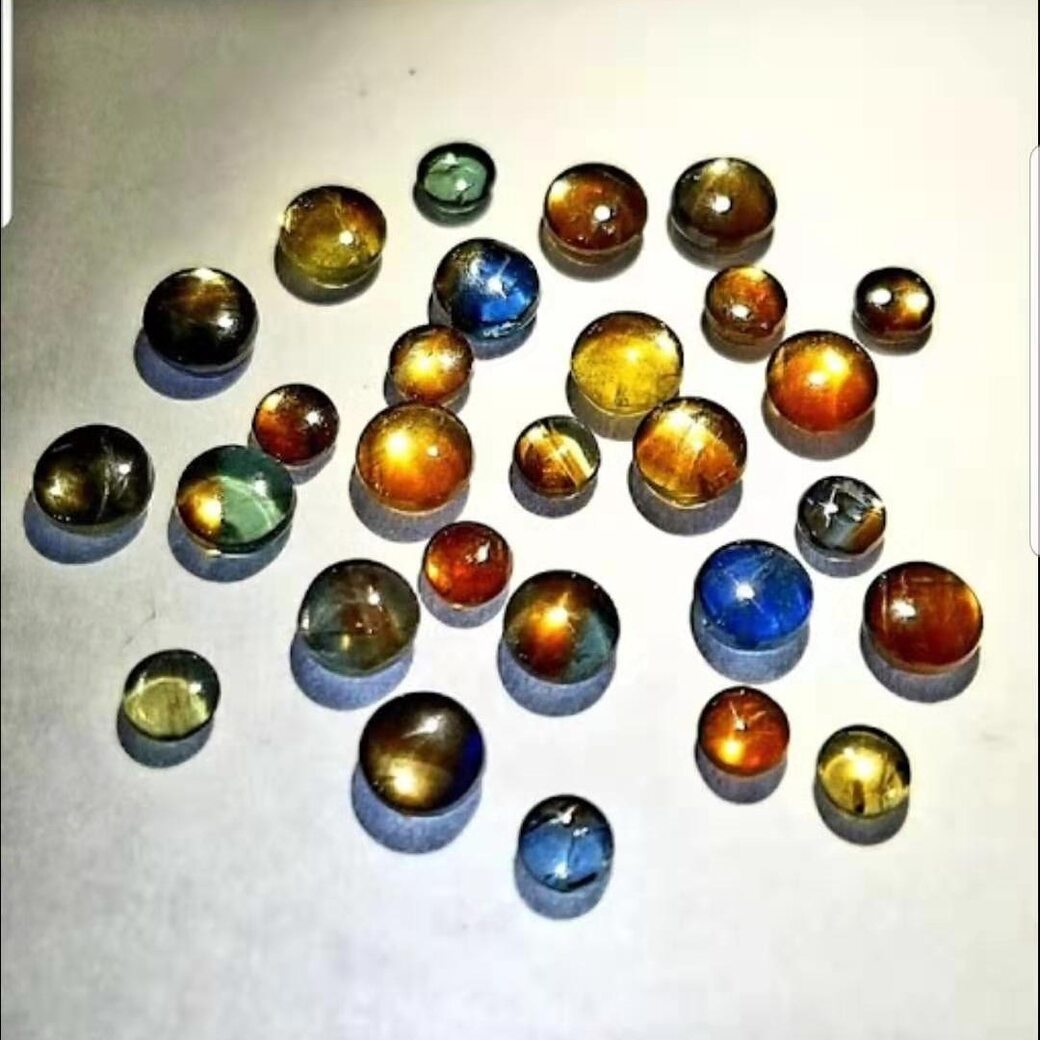
- the same network produces the six-rayed star seen in some cabochons;
- where the inclusions gather in bands, they create the colour zoning.
These inclusions formed by exsolution. Iron and titanium held within the sapphire separated out as the crystal cooled after it formed, growing as tiny needles and plates aligned with the crystal’s structure.
Independent confirmation from GIA
Three later reports in GIA’s journal Gems & Gemology point the same way:
- GIA Bangkok, 2016: examined 14 gold sheen sapphires, from 1.06 to 97.69 ct, and recorded “an abundance of hematite/ilmenite platelets”.
- GIA Tokyo, 2018: examined 23 stones. Raman analysis identified the needles as ilmenite and hematite. The six-rayed stars were caused by reflection from dense clouds of oriented needles, and most of the inclusion phases were iron–titanium oxides.
- GIA, 2026: in a report from the Tucson shows, GIA described the sheen as the result of “oriented platelets and needles of titanium and iron oxides including hematite, ilmenite, and magnetite”.
None of the three reports lists rutile among the inclusions.
And rutile?
Bui and colleagues looked for it specifically. In their samples, “no rutile needles perpendicular to the hematite-ilmenite needles were found by optical microscopy”, and they had not seen a 12-rayed star in any of the cabochons. Their conclusion is direct. Black star sapphires can contain similar hematite–ilmenite inclusions, and “the main difference is the absence of rutile needles from the Gold Sheen sapphires”.
A 2025 study of gold-sheen sapphire from Changle, in China, also attributes the sheen and star to hematite and ilmenite inclusions. I have read that study’s abstract, not the full paper.
To be fair to the evidence: the 2015 search for rutile was made by optical microscopy, and no study can examine every stone. The accurate statement is that the published studies identify hematite and ilmenite as the cause of the sheen and star, and that they found no rutile.
Why the rutile story is so easy to believe
Rutile is the usual cause of stars in gems. In a report on the 2015 Gem-A Conference, published in the same issue of The Journal of Gemmology, star-gem specialist Martin Steinbach is recorded as noting that in 90% of cases the star is due to rutile “silk”. Rutile can even produce a golden star in sapphire. Bui and colleagues describe black 12-rayed star sapphires from Thailand in which a yellow-golden six-rayed star comes from long, thin rutile needles.
So “golden star in a sapphire, therefore rutile” is a reasonable assumption. For gold sheen sapphire, it is simply not what the research shows.
What this means if you are buying
- A rutile explanation in a listing does not mean the stone is not genuine. It does suggest that the description was not checked against the research, so it is fair to ask what the seller’s other details are based on.
- Sheen and star tell you about the inclusions, not the origin. Similar hematite–ilmenite inclusions have been reported in black star sapphires and in gold-sheen sapphire from Changle, China.
- For origin or treatment, ask about the specific stone. A report from a gemmological laboratory is the strongest evidence.
The science of gold sheen sapphire is still being written. We will keep reading the literature and update this page as new research appears.
Sources
- Bui T.N., Deliousi K., Malik T.K. and De Corte K. (2015). From exsolution to ‘gold sheen’: A new variety of corundum. The Journal of Gemmology, 34(8), 678–691. https://doi.org/10.15506/JoG.2015.34.8.678
- Soonthorntantikul W., Atikarnsakul U. and Weeramonkhonlert V. (2016). Lab Notes: Update on spectroscopy of gold sheen sapphires. Gems & Gemology, 52(4). https://www.gia.edu/gems-gemology/winter-2016-labnotes-update-spectroscopy-gold-sheen-sapphires
- Miura M., Katsurada Y. and Saruwatari K. (2018). Gem News International: Update on trace-element chemical characteristics of golden sheen sapphire. Gems & Gemology, 54(2). https://www.gia.edu/gems-gemology/summer-2018-gemnews-update-on-trace-element-chemical-characteristics-of-golden-sheen-sapphire
- Stone-Sundberg J. (2026). Gem News International: Gold sheen sapphire. Gems & Gemology, 62(1). https://www.gia.edu/gems-gemology/spring-2026-gemnews-gold-sheen-sapphire
- Wang S., Li Y. and Shen C. (2025). Gold-sheen sapphire from basaltic lavas, Changle, Shandong Province, China. The Journal of Gemmology, 39(5), 450–465 (abstract). https://doi.org/10.15506/jog.2025.39.5.450
- Gem-A Conference report (2015). Conferences. The Journal of Gemmology, 34(8), p. 717 (Martin Steinbach’s talk on asterism). Same open issue PDF as source 1: https://gem-a.com/images/Documents/JoG/2015/JoG-34-8-LR-3.pdf